Tags: post, autumn, time, seasons
Author: Maz
Date: Saturday August 01st, 2026
Today is the first day of August. Its an important day on the modern neopagan wheel of the year, alternatively called "Lammas" in its Christianized, Anglo-Saxon name, or "Lughnasadh" for the modern neopagan name, with all its deeply patriarchal associations.
Wait, neopaganism is deeply patriarchal? I imagine I'll expand on that in a future post at some unspecified time, but lets just take the name of Lughnasadh as an example; its named after the Irish deity figure of Lugh, who declared this day a day of feasting and celebration and games to commemorate his foster mother, who had literally worked herself to death to make Ireland a verdant and fertile land. Woman works herself to death doing something, man gets his name attached to the celebration of it and hardly anyone remembers her name or acknowledges her work. Does sound kinda patriarchal to me, gotta say. She's called Tailtiu, in case you wanted to know.
I think the first of August is an important day on a much more universally relevant calendar than increasingly mentioned neopagan one, however. By the old calendar, the calendar of growing and being, the calendar of wild things, today is the first day of Autumn.
Huh, how can it be autumn? Its still warm out, I'm still wearing summer clothes, still jamming to those songs of summer.
Work with me and I'll show you how today is the first day of autumn, by some very old measures of the season indeed and some of it even references that neopagan wheel of the year, or at least the older festivals and events that are a part of it. Oh and just for clarity, no, this is not an "old ways were the best ways" psuedo nostalgia for a time that never actually existed, I'll leave that to the fascists.
Its definitely difficult to feel that today is the first day of autumn; climate change is stretching and shifting a lot of seasonal cues and clues, but a lot still remain that people of past generations would be able to recognise and which the majority of other life still observes and follows.
The first clue is in the anglo-saxon name, lammas, or to translate, loaf mass. A religious festival of the first harvest, with the first bread of the beginning of the wheat harvest. That day of first harvest is a lot earlier now, especially on drought and heatwave years like this year, but the seasonality of it is implicit in the name. The harvest has begun, the time of gathering in, of recognising that the growing time is ending and the time of autumn has begun. If your survival for the months ahead is reliant on that seasonal shift to gathering then you're going to be switched on to the beginning of autumn.
It is important to say that its just the beginning of autumn too. All seasons shift gradually from one to the other in a fluid dance, its not a binary switch. Following the pattern and the points of the solar year is all well and good from space, but it doesn't match the lived experience on the planet; solar energy is absolutely the biggest driver of everything, but the sun has its seasons and rhythms too, and the atmospheric effects that the sun drives can have enormous impacts on how the seasons play out also. I'll pick the wild time, not the seasons dictated by an atomic clock.
The clock and the wild do meet in a little observation that shows that the seasons are shifting. August is when you first really notice the change in the light, I find. In my locale, sunset is still happening after 9pm today, having shifted earlier by just over half an hour since the summer solstice. By the end of August sunset will be over an hour later than it is today, the fading of light acellerating towards the equinox. Astronomical twilight, when the sun is 12 to 18 degrees below the horizon, has also returned by August 1st, having been entirely absent in my location in the months around the solstice. This is as easy to observe and recognise that change has happened as it was for countless generations past.
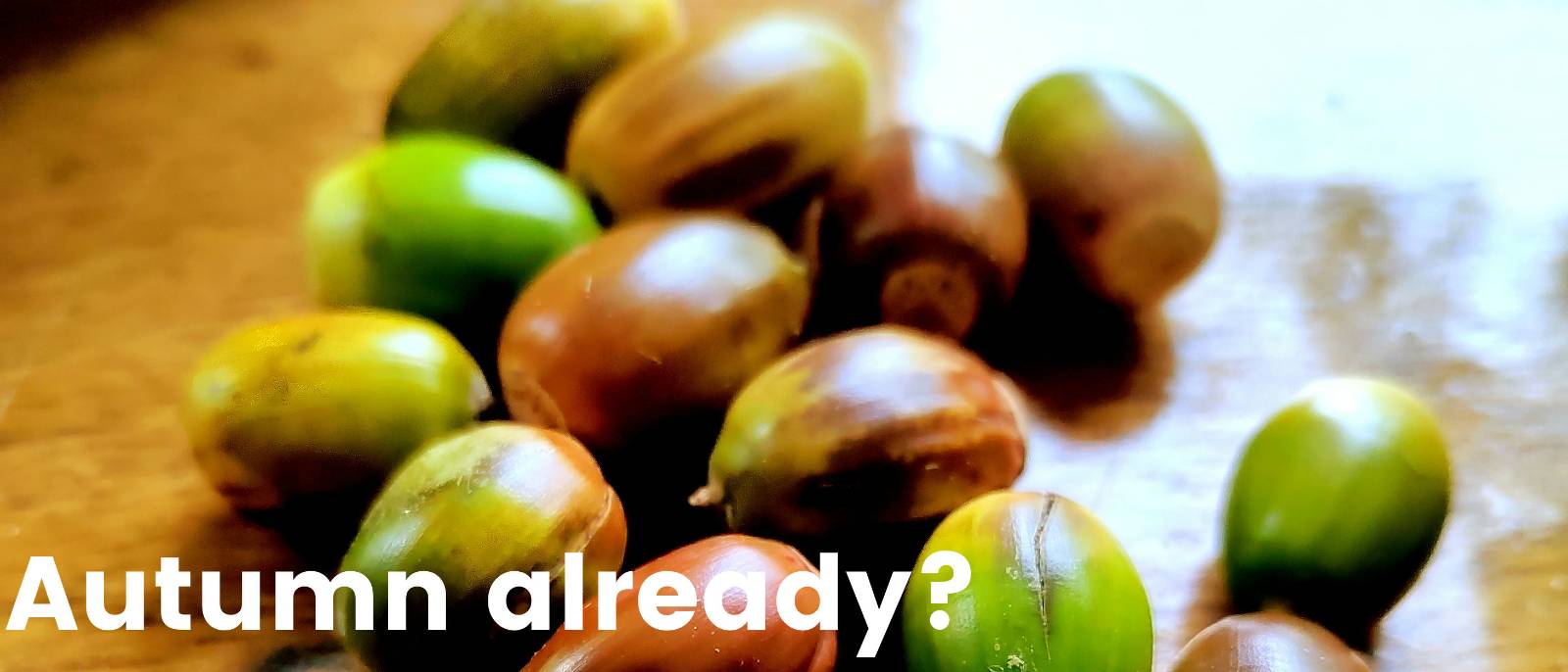
Other life recognises it also. The swifts, so recently screaming black streaks across the blue sky, have suddenly disappeared, heading off on their migration south once more. They're not the only migrant birds that disappear once August comes too. Swallows and house martins may hang on well into September, if the food is good, but almost all of the other summer breeding migrants will be gone in August also. In the hedgerows and field edges, summer plants are running to fruit and seed, or even earlier with this year's weather. Summer bright greens are now deep and dark in August, as if they are weighed down with the effort of keeping it all going with hours less of light to capture. The first dropped leaves are already underfoot.
We're not very good at paying attention to wild rhythms and the connection to life and place that they offer. We look at weather forecasts to see what we should wear and temperature swiftly becomes the sole arbiter of seasonality. Prevaling modern culture sells seasonality to us meanwhile, shoving the latest sweaters and boots at us while clutching pumpkin spice lattes. Like in so many examples, capitalism takes something that is freely available to us and packages it up to sell us things, distracting us from the fact that we can have that feeling for free if we just looked around.
On the wheel of the year, the fire festivals like lammas/Lughnasadh are usually described as being between the solar festivals, of celebrating the mid-points between those, the equinoxes and solstices given the greatest prominence because neolithic henge builders. I see the appeal of that thinking and its certainly good to notice the observed connections that neolithic people had to the cycle of the year, but there is a different perspective you can take on it.
What if the fire festivals aren't situated as midpoints between solar festivals, lesser points between the greater, but are situated either side of the solar points to deliniate that we are now entering a different seasonal period?
That might sound like entirely semantics, but stick with me. The seasons of extremes, summer and winter, starting with Beltane and Samhain, both build to a solar crescendo and then descend/ascend from that peak/depth until the point at which a seasonal change can begin to be observed and felt into the seasons of transition of spring and autumn, at Imbolc and Lammas/Lughnasadh. These seasons of change then build to their solar tipping points and progress from there until once again the next seasonal change can be clearly observed and felt.
This makes a great deal more sense to me than "the seasons begin and end at the solar points" approach. Its grounded in the land and the lives of countless living things on the land, not just looking to the skies. Why don't we look up and look around together? It makes the 4 seasons into points of "change is happening, but look, more change is yet to come".
Just to throw another wild thought into the mix before I finish, but what if the 4 seasons aren't the only seasons? What if, as is often incorrectly attributed to the wheel of the year, there are even more than the 8 "seasons" from there? What if there are multiple seasons and they're not all of the same uniform length?
This is a project I've been working on for a while, gathering thoughts and observations and data. Eventually I'll have more I can write about, but I will say that comparing the start of one of the traditional 4 seasons to the end of the same season is to see how wildly different they can be and that its laughable to lump them in together.
I imagine I'll be using the phrase "wild time" in my writing a lot more too, quite possibly my most repeated phrase of the year! There'll be more about that eventually also. Happy first day of August and start of autumn (or spring, if you live beneath southern skies and stars) to everyone. I hope its a season that treats you kindly.
Tags: post, nature, connection, time, summer, morning
Author: Maz
Date: Friday July 31st, 2026
"Its amazing how much I've embraced being a morning person recently" I think to myself as I easily slide off the bed and look out of the window at the day.
An externally imposed change of routine has me rising earlier and finding myself falling asleep on a different side of midnight than is typical for me.
"Who knew I could be such a morning person," I continue, as if the only thing that has changed is the numbers on the clock, "I wonder if....oh" as the realisation finally hits.
We are creatures of such short memories at times, us human beings. How soon we forget that the season we are in is not the season that we will always be in. Its so much easier to be a morning person in the summer, even in the heatwaves the morning is the easiest part of the day. I'm playing through a game on easy mode and thinking I'm suddenly an incredibly skilled gamer, rather than the game is going extremely gently on me.
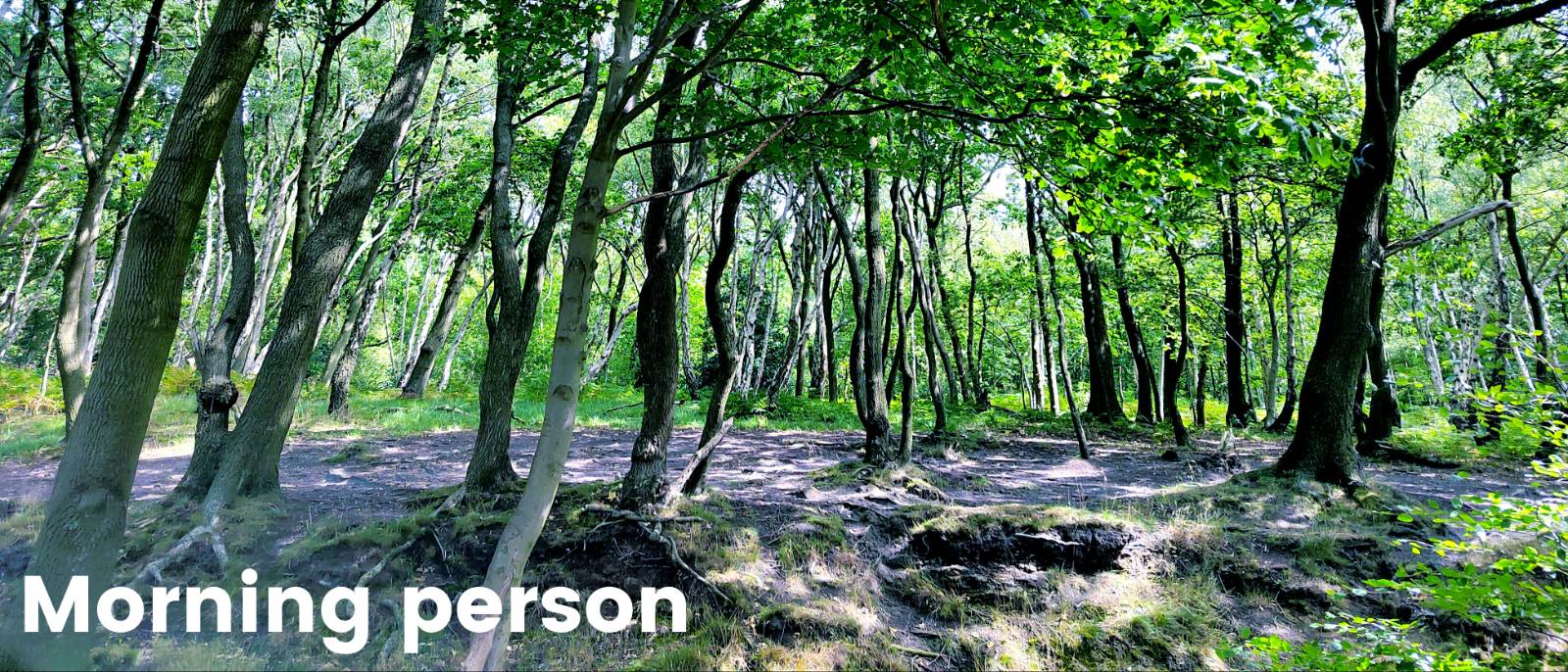
Of course mornings are easier in the summer, we're genetically coded and biologically built for it. Lighter, warmer mornings are inviting, enabling and our bodies respond to it, sliding on in with a minimum of effort. We're connected, living on wild time, in rhythm with the season.
Then comes those winter mornings; dark, cold, repelling. Yet we follow the clock as if the days are somehow the same, wild time is abandoned, now we're living on capitalist time.
Summer morning us still struggles to remember it, though. Its like a circle of pixies are dancing happily in our heads, singing "This is how it shall always be, for forevermore!".
I think we really could all learn a lot from these summer mornings and its not that summer mornings are easier in and of themselves (spoiler alert, they are) but its really that wild time is easier to follow, we just happen to overlap it more in the summer.
What could life be like if we followed wild time all the year, I wonder?